
In land use planning, different needs and perspectives are reconciled. The aim is to create a functional, pleasant and safe living environment for everyone.
Planning therefore requires cooperation and interaction between stakeholders, planners, authorities and decision-makers. Parties to the plan are given the opportunity to participate in the preparation of the plan, assess its impacts and state their opinions in writing or orally.
Who can participate?
Parties to the plan have the right under the Land Use Act (section 62) to participate in the preparation of the plan, assess its impacts and present their opinions. A party is an entity whose housing, work or other conditions the plan may significantly affect. Parties include, for example, landowners, local residents and users as well as authorities and organisations.
When and how can you participate?
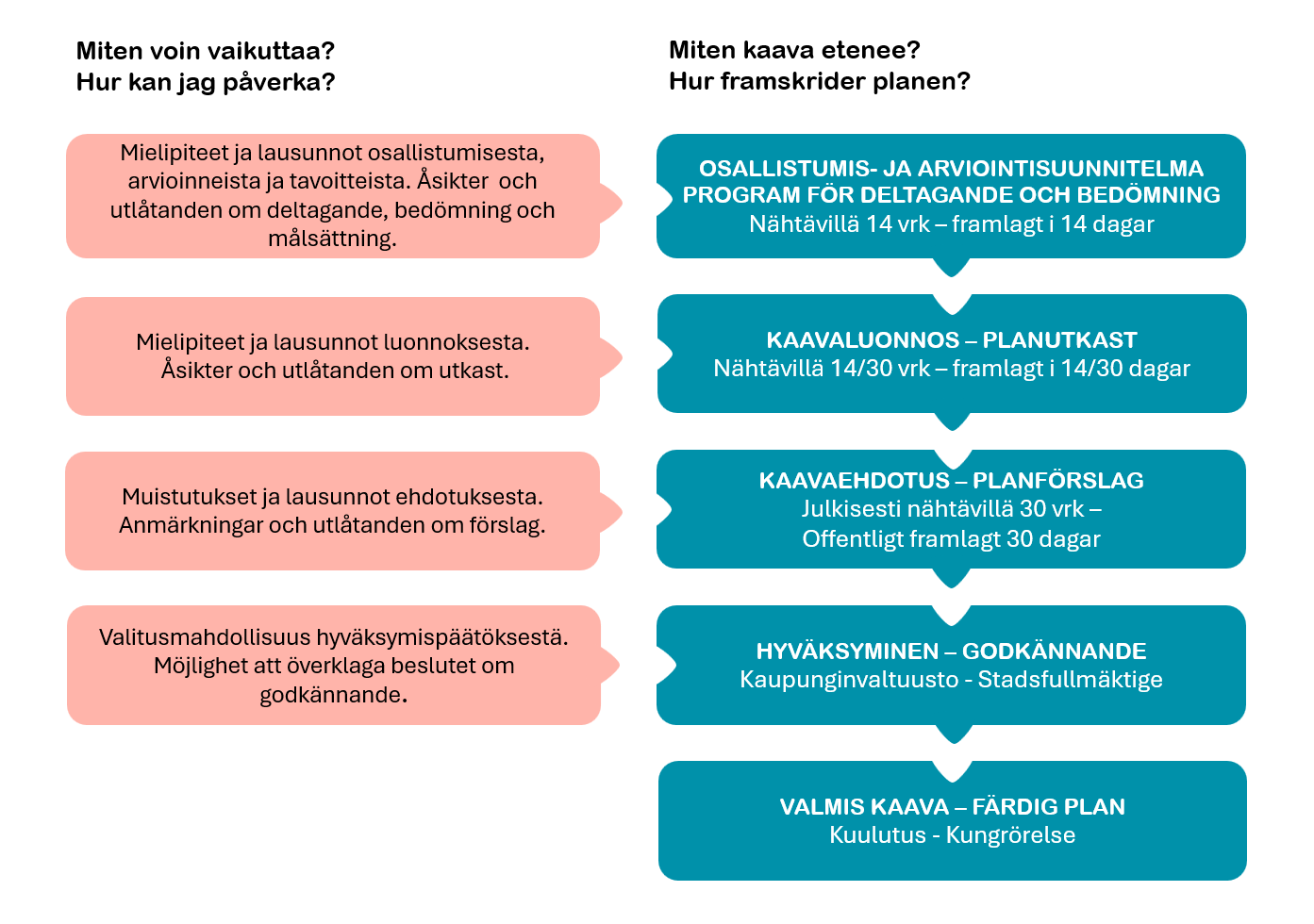
Planning is a multi-stage process from the initiation of a plan to its approval. The nature and significance of plans affect the course and duration of the process. For example, in significant local detailed plans or master plans covering large areas the process is broader and there are often more opportunities to participate. It is possible to participate in different ways in the various stages of the planning process.
1
Initiation
The initiative to draw up a plan may be taken by a landowner or various municipal bodies. A plan or amendment to a plan is started if the city considers it appropriate.
In the early phase of the planning project a plan for how the project will proceed is prepared, called the participation and assessment plan (OAS). It explains the objectives and starting points of the planning work, how preparation and decision-making will proceed, how to participate in the preparation, and how the plan’s impacts are assessed. The participation and assessment plan also explains how the progress of the planning work will be communicated.
How can you participate?
Participation by presenting an opinion or statement during the exhibition period of the OAS. Parties are heard regarding the starting points and studies, the schedule of the planning work, preliminary objectives, definition of parties and arrangements for interaction.
2
Draft stage
After the participation and assessment plan the preparation phase begins. During the preparation phase draft plans are prepared in cooperation with experts from different fields. Participants may include traffic planners or building designers, for example. One or more draft plans are put on public display. In addition, other material such as studies or illustrative images may be on display.
How can you participate?
Participation by giving an opinion or statement during the draft plan’s public display. Parties are heard regarding the plan’s objectives, investigative work and the draft plan.
3
Proposal stage
On the basis of the preparation material a proposed plan is drawn up, which as far as possible takes into account previously received opinions. The proposal is the planning department’s final view of the area for decision-making. The proposal includes the plan map with plan symbols and regulations, as well as the plan report.
How can you participate?
Participation by filing an objection or statement during the public display of the proposed plan. Parties are heard regarding the proposed plan and the plan report.
4
Adoption
The plan preparer prepares responses to received statements and objections and modifies the proposal as necessary. The city’s reasoned position is mailed to those who submitted an objection and provided their address. If the changes made are significant, the proposal is made publicly available again.
A change to a local detailed plan that is not significant in its effects is approved by the Urban Environment Board. If the plan has significant impacts, the proposed plan proceeds to the City Board and then to the City Council for approval.
It is possible to appeal an adopted plan to the administrative court concerning a possible error during the planning process. If no appeal is made against the approval decision, the plan becomes legally valid approximately two months after the approval decision.
At different stages of the planning process public events, workshops, surveys and plan walks and other similar events can be arranged. These are used to collect views and engage in dialogue.
The planning material concerning the plan is published on the project’s webpage at the time of public display. The local detailed plans currently on display are collected as a separate highlight at the top of the Ongoing local detailed plans page.
The Finnish planning system has three levels of plans, and it is possible to participate in the preparation of all plans. A more general plan always guides a more detailed one. The regional plan is the most general of the plan levels and is prepared by the regional council. Municipalities prepare master plans and local detailed plans. Of these, the local detailed plan is the most detailed and regulates land use in detail. Planning is also guided by national land use objectives prepared by the Government.
-
Urban Planning

Opening hours
Please arrange an appointment in advance.Mon–Thu 8-16
Fri 8-15


