
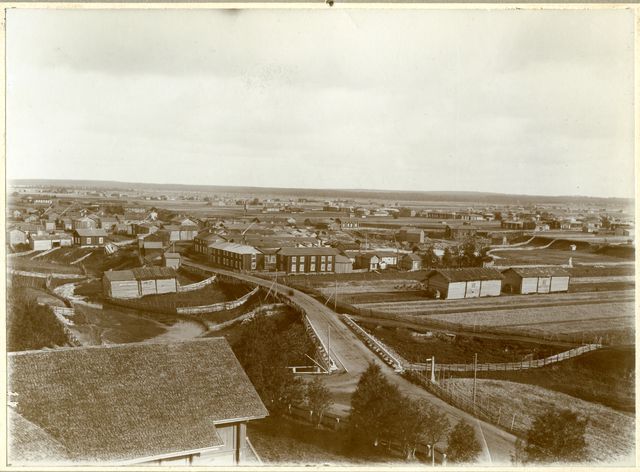
Today’s actions affect tomorrow’s cultural heritage.
The Ostrobothnian Museum operates as an expert in the cultural heritage in Ostrobothnia. Its activities focus on the preservation, care and developing of the cultural environment, but important tasks also include preserving and dissemination of information about the cultural environment. Particular attention is paid to the quality and usability of the information.
The Museum operates in the Ostrobothnia region in cooperation with municipalities, various authorities, associations and communities as well as companies and private property owners.
The Museum provides official statements concerning built heritage and the cultural environment in relation to planning, construction and other land use. Authority statements are a central part of cultural environment work.
We use the electronic permit services ePermit and Lupapiste. Requests for statements with attachments should be sent to museo.lausunnot@vaasa.fi
Division of responsibilities between The Ostrobothnian Museum and the Finnish Heritage Agency
The Ostrobothnian Museum is a regional actor and handles in the Ostrobothnia region matters that concern
- sites of local significance
- sites and environments protected by local detailed and master plans
- regionally significant cultural environments
- nationally significant landscape areas (VAMA areas)
- nationally significant built cultural environments (RKY areas).
The jurisdiction of the Finnish Heritage Agency includes
- buildings protected by law
- church heritage protected under the Church Act
- matters related to the preservation and repair of the built heritage of state-owned buildings and university buildings.
The Museum provides advice on repair construction and the care of the cultural environment and offers guidance on repair grant matters. Advice and guidance are offered to private homeowners, municipalities and associations as well as communities. The service is free of charge.
The service is provided by the museum’s building researchers.
Planning a renovation?
Preparing a building history report (RHS) is a good way to begin familiarizing yourself with a building and its phases. When starting renovation work on buildings, it is important to know the history and phases of alteration of the site/buildings and to examine the building’s current condition. The history of alterations often reveals the reasons for the current condition.
It is good to document the building’s current condition when planning repair work. In documentation it is advisable to systematically go through the site describing and recording the basic facts about structures and materials. At the same time, write down any possible problems and damages.
With good background information about the site, it is easier to find the causes of problems and then direct the necessary repairs to the right places and to the correct extent. It is important not only to repair the damage but also to address the cause of the damage.
According to the principles of preservation-oriented repair, it is always important to consider what can be repaired and what needs to be replaced. When replacing structural parts, it is advisable to use similar materials that match those found elsewhere in the structure to ensure that everything functions as a whole. It is also worth considering the extent of the repair.
More information on conservation repairs and traditional construction:
- Korjaustaito (Finnish)
- The repairer’s path (Finnish)
- Komeat pohjalaiset talot (Finnish and Swedish)
- More information in Swedish on the Hålla Hus site.
In the municipalities of Ostrobothnia, cultural environment reports and building inventories are conducted in connection with land-use planning, thereby increasing knowledge about the region’s cultural environment. The Ostrobothnian Museum participates in these inventory projects as an expert and contributes to the evaluation of sites within assessment working groups. While these inventories and cultural environment reports serve as background information for various studies and reports, their primary purpose is to support municipal land-use planning, such as zoning or road planning. Furthermore, the Regional Council of Ostrobothnia has conducted regional-level inventories of cultural landscapes and the built environment for the purpose of regional land-use planning.
The museum’s own inventories focus mainly on researching regional phenomena.
Architectural history reports (RHS) are also prepared for buildings. These reports document the construction and operational history of a property, as well as the various stages of its construction and subsequent alterations. Understanding past modifications, repairs, and extensions often helps in resolving current issues and identifying the causes of any damage. An architectural history report is a valuable tool for property owners in managing their building, and it is well worth commissioning or preparing one. The guide Talon tarinat – Rakennushistorian selvitysopas (“Stories of the House – A Guide to Architectural History Reports”), published by the Finnish Heritage Agency in 2010, can assist in the preparation process.
For the national cultural environment, the RKY 2009 inventory confirmed by the Government is in use. As a result of the inventory a total of 86 areas and sites from Ostrobothnia are defined as nationally valuable.
There are 9 nationally valuable landscape areas in the Ostrobothnia region. These landscape areas have been updated by a Government decision in 2021.
Ostrobothnia also includes the UNESCO World Heritage site the Kvarken Archipelago
From the Finnish Heritage Agency’s KYPPI portal you can search for various cultural environment site data as well as information on sites protected by special law. The portal also provides reports and studies archived by the Finnish Heritage Agency.
KIOSKI inventory application
The Museum maintains a regional building heritage inventory application together with Seinäjoki Museums, K. H. Renlund Museum and the regional councils of Ostrobothnia. The KIOSKI 3.0 application is intended for authorities’ use, but some site-specific data has already been made available through the National Land Survey of Finland’s map services, Liiteri and Paikkatietoikkuna.
In Liiteri, you can find information about specific sites by selecting Map Layers/All Layers/Cultural Environment/Regional Inventories/Inventory sites and areas in Southern Ostrobothnia, Central Ostrobothnia, and Ostrobothnia.
In Paikkatieto-portal, information about specific sites can be found by selecting the ‘Buildings’ layer under ‘Sites and areas from inventories in South Ostrobothnia, Central Ostrobothnia, and Ostrobothnia’.
Finnish Heritage Agency
Grants for the restoration of buildings and cultural environment sites
The Finnish Heritage Agency can award discretionary subsidies for the restoration and conservation of culturally and historically valuable buildings. The aim of the subsidies is to preserve valuable built cultural heritage as part of the national cultural heritage and to support the preservation of building restoration techniques. The application period is open annually in October–November.
The Finnish Heritage Agency grants subsidies for the repair of museum buildings. The goal of the subsidies is to support, among other things, the preservation of local museum collections and buildings, as well as the dissemination of information regarding museum collections and local heritage. The application period takes place annually in September–October.
The Ministry of the Environment allocates funding to the Economic Development Centres each year to be distributed as grants for the maintenance of built heritage. The application period is open annually in October–November.
The Finnish Local Heritage Federation
The Finnish Local Heritage Federation awards annual support for the repair of Finnish community centers. The purpose of the grant is to preserve the cultural-historical built heritage of community centres, enable repairs that preserve the buildings’ special features and necessary alterations that improve usability. The grant is intended for essential repairs to traditional, established community centres. The application period is open annually in September.