

Read about the City of Vaasa’s sustainable procurements that promote environmentally friendly solutions and support sustainable development.
Public procurements
Public procurements offer significant opportunities to reduce the greenhouse gas emissions and the use of natural resources of the public sector. Cities can reduce the climate impacts of procurements by taking into account the greenhouse gas emissions of products and services. The City of Vaasa can also support low-carbon and circular-economy-promoting solutions by using its purchasing power to procure goods, services and contracts with lower environmental and climate impacts.
Procurement assessment and criteria
The environmental criteria in procurement have developed in recent years, as the approach has shifted from general conditions towards procurement-specific conditions. From general conditions, the City of Vaasa has used, for example, the international ISO 14001 environmental certificate and emission class requirements in the case of transport services.
Below you will find further information about the city’s procurements and how environmental and climate matters have been taken into account in them.
Car-sharing vehicles
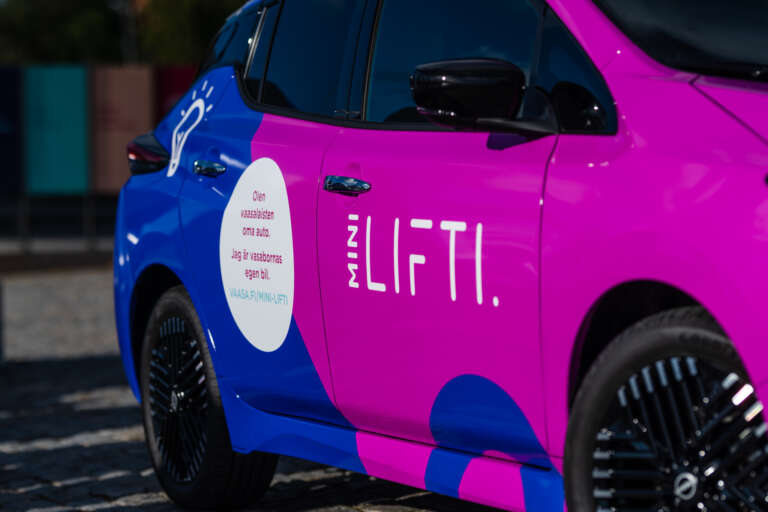
The City of Vaasa updated the Mini-Lifti car-sharing vehicles on 1 July 2024. The city’s car-sharing vehicles operate on carbon-neutral electricity, and the new cars have a longer driving range than before, which diversifies the ways the cars can be used. Car-sharing vehicles reduce private car use, traffic congestion as well as emissions and noise from traffic. The city currently has three car-sharing vehicles, which are available to city employees during working hours and can be reserved by anyone outside working hours. During the summer the cars are freely rentable by anyone even during working hours.
Omago is responsible for the operation of the Mini-Lifti vehicles; it owns the cars and is responsible for their maintenance, cleanliness, insurance and the mobile app. Reservations and opening car doors are handled via a mobile application. See more detailed rental and usage instructions on Omago’s site.
Impact: Reduction in CO2 emissions.
Emission class requirements in procurement for machines and vehicles
The procurement’s emission class requirements have been taken into account as follows: at least EURO V and Stage III B emission class. In addition, for motor graders the year of commissioning had to be 1989 or later, and for suction sweeping vehicles 2003 or later. The grouping and classification of work machines follow the current classifications for earthmoving machines, which have been published in the joint online publication of INFRA ry and Koneyrittäjät ry.
These requirements significantly reduce the amounts of nitrogen oxides, hydrocarbons, carbon monoxide and particulate emissions, which improves air quality. Newer and more energy-efficient machines consume less fuel, which in turn reduces carbon dioxide emissions. Commissioning requirements ensure the use of more modern and less polluting equipment, and compatibility with the latest environmental requirements supports the achievement of carbon neutrality goals.
Impact: Reduction in emissions.
Waste transport to Stormossen
The minimum requirement set for the procurement was EURO 6 emission classification and, for diesel vehicles, the use of renewable diesel fuel and, for gas vehicles, biogas. According to measurements by VTT, the nitrogen oxide and particulate emissions of EURO 6 vehicles are significantly lower compared to earlier emission classes, so meeting the emission classification promotes emission reduction and the utilization of cleaner fuel types.
Impact: Reduction in emissions.
Employer bike benefit for city staff
Offering an employer bike benefit to staff supports the City of Vaasa’s strategic carbon neutrality target and improves staff wellbeing. The benefit encourages employees to cycle and can also positively affect recruitment and retention. The benefit has been tendered and is procured as a service from a company specialised in administering bike benefits. Around 10% of the city’s staff have adopted the employer bike benefit.
Impact: Reduction in CO2 emissions.
Cycling Alliance
About 80% of Vaasa residents live within cycling distance (under 5 km) of the city centre. The alliance promotes the city’s goal of becoming carbon neutral by the end of the decade by increasing the modal share of cycling and thereby reducing carbon dioxide emissions from transport.
Impact: Reduction in CO2 emissions.
Procurement of carbon-neutral electricity
The City of Vaasa has switched to procuring carbon-neutral electricity as of 1 January 2023. The City of Vaasa’s Premises Management Office monitors electricity price developments and will reassess the matter if the price difference between green electricity and carbon-neutral electricity changes significantly.
Impact: Reduction in CO2 emissions.
Vaasa region public transport biogas buses
Vaasa has been a persistent pioneer in implementing environmentally friendly biogas-powered public transport. The regional public transport of the City of Vaasa and the Municipality of Mustasaari, Lifti, started operations on 1 July 2022. Lifti runs on biogas produced by Stormossen. Biogas is a renewable fuel that generates 85–90% less harmful emissions to the environment than petrol or diesel. Biogas is also part of the circular economy, as it is produced from biowaste and sewage sludge.
Impact: Reduction in emissions and promotion of the circular economy.
Fresh vegetables, fruit and potatoes
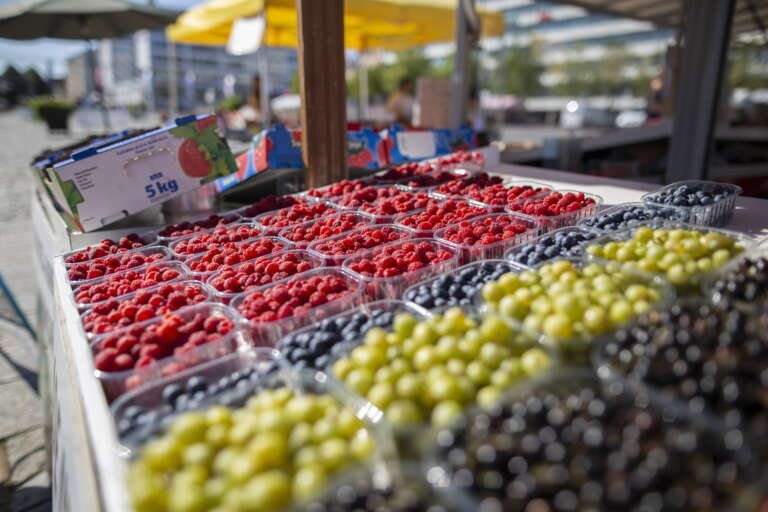
In the quality scoring, the supplier’s ability to deliver products in the lot sizes requested by the ordering party has been taken into account so that by regulating lot sizes the amount of waste could be reduced.
Impact: Reduction in food waste.
Multifunction devices
The city introduced a new multifunction device agreement in May 2022. The objectives of the agreement are particularly energy savings, better workplace comfort and cost-effectiveness. The new devices have a motion detection feature so that the device starts automatically when the user approaches it and turns off when it is not used. In addition, the devices allow remote printing, and printouts can be collected when it suits the user best.
Impact: Energy savings.