
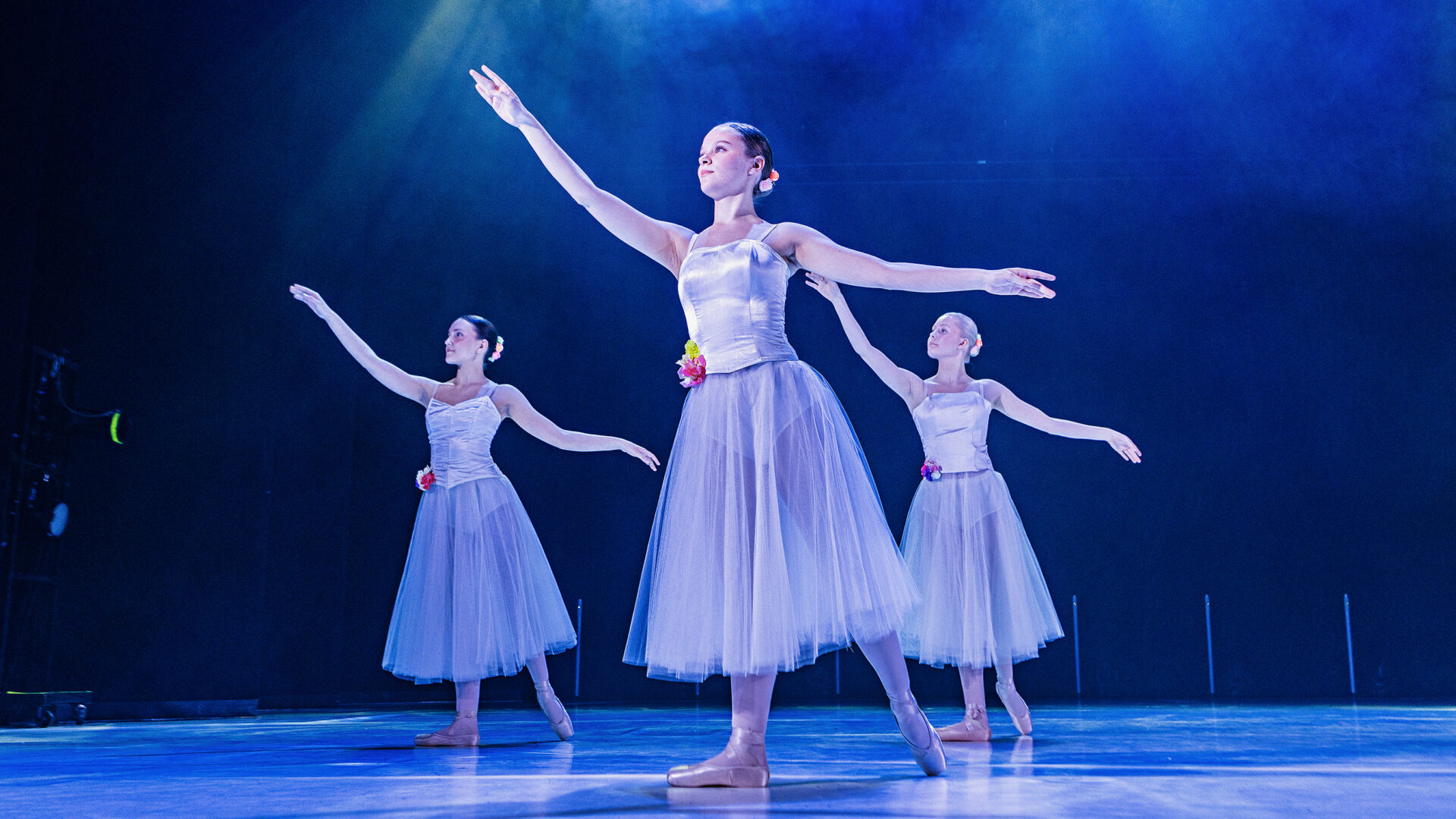
In dance studies you express yourself, develop skills and find your own way to move. At TaiKon you can study ballet and contemporary dance in groups aimed at children and young people.
Study progression in dance arts
- early childhood dance education (4–6-year-olds)
- core studies (7–15-year-olds)
- advanced studies (15–18-year-olds)
Early childhood education
In early childhood education, 4–6-year-old children are introduced to dance and other art forms through joy, play and creative activities. The groups are:
- Theatre-dance-circusmix
- Dancemix
Core and advanced studies
Dance education for 7–18-year-olds is based on the extended syllabus of basic education in the arts. The studies are divided into core studies and subsequent advanced studies.
Groups are selected primarily based on the pupil’s year of birth.
You can choose a main dance style:
- ballet
- contemporary dance
If you wish, you can study both dance styles and broaden your dance studies.
Complementary studies
From around age 11–12, studies also include complementary studies for the main dance style. They support the development of dance technique, expression, performance skills and creativity.
Complementary studies (TOP) can include, for example, jazz dance and other dance techniques that support the main dance style, as well as acrobatics, basics of choreography and work on pieces. Some studies can be implemented in periods.
Course offering
Early childhood education in dance arts
In the Theatre-dance-circusmix the child gets to explore three different performing arts forms. Interest in learning and in different art forms is awakened through joyful and playful activities.
In the lessons the child practices skills for working in a group and is introduced to expression through their own body. Basic skills in theatre, dance and circus are practised by utilising and respecting the child’s natural imagination.
Teaching groups
Theatre-dance-circusmix for 4–5-year-olds
- In a child–parent group the child and an adult participate together in the lessons
- The group meets once a week
- Teaching period 8 weeks
- 45 min / week
Theatre-dance-circusmix for 5-year-olds
- The group meets once a week
- 45 min / week
Theatre-dance-circusmix for 6-year-olds
- The group meets once a week
- 45 min / week
Theatre-dance-circusmix for 7-year-olds
- The group meets once a week
- 60 min / week
In the Dancemix the child’s interest in learning and in different dance styles is awakened through joyful and playful activities.
In the lessons the child practices skills for working in a group and is introduced to expression through their own body. The basics of dance are practised by utilising and respecting the child’s natural imagination.
- The group meets once a week
- 45 min / week
Core studies in dance arts
The Ballet start and the Contemporary dance start is the first stage of basic dance studies. In the start studies there are two options for the dance style: ballet and contemporary dance.
The lessons introduce the basics of dance technique and practise motor skills and working methods appropriate to the style. The aim is for the child to experience the joy of dance and learning and to become interested in practising dance.
The starter stage lasts two years and groups are formed primarily by age: 7-year-olds and 8-year-olds. Some teaching is carried out as a combined group.
Dance class is held once a week. If the child wants to dance more, they can also participate in another starter group of the same age group and study both ballet and contemporary dance.
Teaching is available
- on Monday afternoons at Sundom School
- on weekday evenings in Vaasa
At this level there are two options for the main dance style: ballet and contemporary dance.
In dance classes the basics of style-specific technique, motor skills and working methods are practised. Training progresses while respecting each individual’s body and dance readiness is developed through positive dance experiences.
Groups are formed primarily by age: 9-year-olds and 10-year-olds. Some teaching is carried out as a combined group.
Groups rehearse twice a week. Teaching is organised in Vaasa.
We collaborate with Musiikkiopisto Legato (Music Institute Legato) and Mustasaaren musiikkiopisto (Mustasaari Music Institute). Contemporary dance pupils from these institutes can at this study level practise one of the weekly sessions in their own locality (Maalahti, Mustasaari) and the other at TaiKon in Vaasa.
At this level there are two options for the main dance style: ballet and contemporary dance.
Dance readiness is developed through joy and shared dance experiences.
Training progresses step by step towards improving style-specific body and movement control as well as dance technique. The aim is for the pupil to become interested in different possibilities for using the body and expression and in using music in different dance styles.
Groups are formed primarily by age: 11-year-olds and 12-year-olds. Some teaching is carried out as a combined group.
Groups practise their main dance style twice a week. In addition, training in other dance styles and subjects (TOP) that complement it begins at this stage of the studies.
Advanced Studies in Dance Arts
At this stage there are two options for the main dance style: ballet and contemporary dance.
In this final stage of the basic dance studies, training progresses towards more challenging movements and sequences. The aim is that the pupil acquires the knowledge and skills that enable them to move on to advanced dance studies.
Training progresses while respecting each individual’s body. Dance readiness is developed through shared dance experiences.
Groups are formed primarily by age: 13-year-olds and 14-year-olds. Some teaching is carried out as a combined group.
Groups practise their main dance style twice a week and a complementary dance style or subject (TOP) once a week. Some teaching can be implemented in periods.
At this stage the pupil deepens their skills in the dance styles they practise, in movement improvisation and in creating their own movement. The aim is to learn to perceive dance as an art form in relation to other arts and society and to gain qualifications for professional studies in the arts.
Groups are formed according to the pupils’ skill level. Some teaching is carried out as a combined group.
Groups practise their main dance style twice a week and a complementary dance style or subject (TOP) once a week. Some teaching can be implemented in periods or, for example, as production activities.
Advanced dance studies include a final project.
Applied Studies
Applied studies are advanced short courses for 13–18-year-olds interested in various arts.
All young people can participate in applied courses regardless of previous experience, and participation does not require being a pupil in basic arts education. Applied studies are offered throughout the study programme.
Also see
Contact us
-

Turkki Nella
Coordinating teacher, performing arts, Vaasa City Institutes
Responsibilities: Performing arts, Dance art, Contemporary dance, Theatre art, Circus art
-
Eskola-Råberg Johanna
Full-time Dance Teacher, Vaasa City Institutes
Responsibility: Ballet
-
Kankaanpää-Ahosola Iiris
Full-time Dance Teacher, Vaasa City Institutes
Responsibility: Ballet
-
TaiKon
TaiKon offers qualitative basic education in arts in Vaasa to children and youngsters.

Phone
Enquiries related to teaching (Dance, Theatre, Circus): 040 183 8438Enquiries related to teaching (Fine arts, Handicrafts, Media arts): 040 744 5582Customer Service in Finnish: (Mon–Fri 8–16): 0400 868 110040 198 1261Customer Service in Swedish: (Mon-Thu 10–14): 040 629 9133Invoicing (Mon-Thu 10–14): 040 629 9133

Email

Address
Kasarmi 11, Itäinen Kasarmintori 7-9, 65100 Vaasa
- The building is accessible. The accessible entrance is located through the basement-level door (Artellikuja). The door is on the building’s lower ground floor, and an elevator is available on the basement level.
- Please call us and we will come to open the door:
- 040 744 5582 Coordinating Teacher (evenings, Mon–Wed)
- 040 352 6083 Full-time Teacher (evenings, Mon–Thu)
- 040 179 9681 Producer (during office hours)
- 040 614 8628 Senior Attendant, In-house Services (during office hours)
- Two parking spaces near the basement entrance are reserved for people with reduced mobility.
- Two toilets are accessible and adapted for people with reduced mobility.