
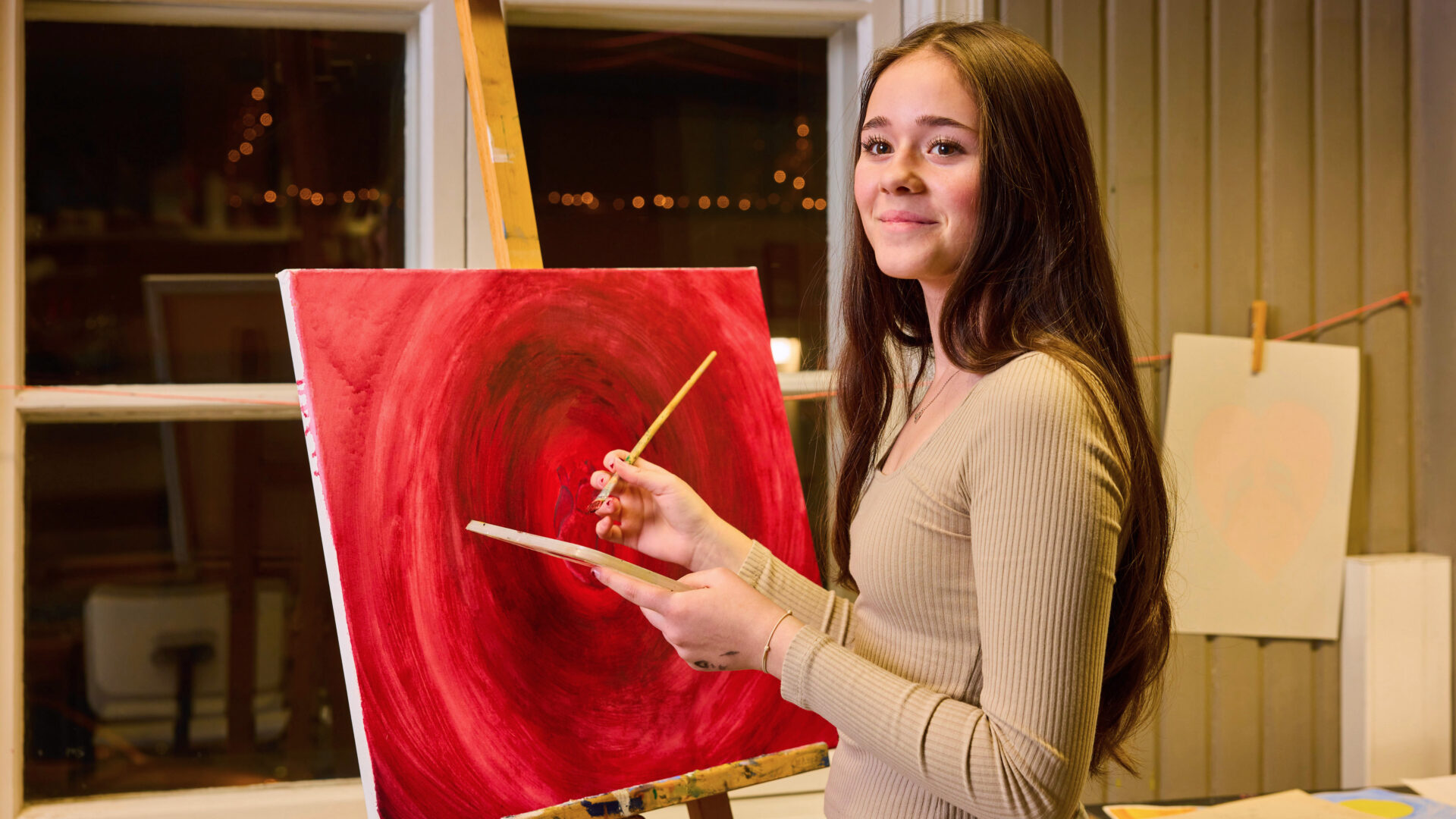
In fine arts studies, one expresses oneself through image and form using various techniques. The studies introduce, among other things, painting, drawing, printmaking, three-dimensional work, media art and photography.
Study progression in fine arts
- early childhood studies (ages 4–5)
- core studies (ages 6–14)
- advanced studies (ages 15–18)
Early childhood education
Fine arts education for 4–5-year-olds is organised in Fine arts–craftsmix groups. The teaching combines fine arts and crafts. Children get to try different materials, tools and working methods through play and creative activities.
Core and advanced studies
Fine arts education for 6–18-year-olds is based on the extended syllabus of basic education in the arts. The studies are divided into core studies and subsequent advanced studies.
Course offering
Early childhood education in fine arts
We explore colours and observe the environment through crafts and fine arts, through play and experimentation.
- The group meets once a week.
- Teaching period 8 weeks
- 45 min / week
The Fine arts–craftsmix early childhood group is suitable for both new pupils and those who have previously participated in the teaching. A guardian may attend the class.
Basic studies in fine arts
We explore the basic techniques of fine arts and crafts, with pupils’ own imagination and creativity as starting points. Through stories and myths, we examine art history and craft traditions.
Children explore materials and tools, get to discuss their own and others’ works, and learn to understand that art is a language of many means of expression.
TaiKon organises after-school teaching for 1st–2nd graders in schools in Vaasa.
We explore the basic techniques of fine arts and crafts, with pupils’ own imagination and creativity as starting points.
Children familiarise themselves with materials and tools, get to discuss their own and others’ works, and learn to understand that art is a language of many means of expression.
We practise traditional working methods such as drawing, painting, image-making and printmaking. Inspiration comes from art-historical works as well as pupils’ own worlds and the local environment.
We practise expressing our own feelings and thoughts in works using a wide range of techniques. Inspiration comes from works by various artists from the past century.
We work on individual projects planned and carried out by pupils themselves. The works seek inspiration from contemporary art as well as pupils’ own interests within visual culture.
Advanced studies in fine arts
Pupils deepen their skills in areas of visual arts they are personally interested in and have the opportunity to develop their own artistic expression. The aim of the studies is for pupils to produce a final project as part of the advanced visual arts studies.
Applied studies
Applied studies are advanced short courses for 13–18-year-olds interested in various arts.
All young people may participate in the applied courses regardless of previous experience, and participation does not require being a pupil of basic education in the arts. The applied studies are offered throughout the entire study programme.
See also
Contact us
-

Johansson Mirka
Coordinating teacher, visual arts, Vaasa City Institutes
Responsibilities: Visual arts, Visual art, Crafts, Media art
-
Alho Alli
Full-time Teacher, Visual arts, Vaasa City Institutes
Responsibilities: Visual arts, visual art
-
TaiKon
TaiKon offers qualitative basic education in arts in Vaasa to children and youngsters.

Phone
Enquiries related to teaching (Dance, Theatre, Circus): 040 183 8438Enquiries related to teaching (Fine arts, Handicrafts, Media arts): 040 744 5582Customer Service in Finnish: (Mon–Fri 8–16): 0400 868 110040 198 1261Customer Service in Swedish: (Mon-Thu 10–14): 040 629 9133Invoicing (Mon-Thu 10–14): 040 629 9133

Email

Address
Kasarmi 11, Itäinen Kasarmintori 7-9, 65100 Vaasa
- The building is accessible. The accessible entrance is located through the basement-level door (Artellikuja). The door is on the building’s lower ground floor, and an elevator is available on the basement level.
- Please call us and we will come to open the door:
- 040 744 5582 Coordinating Teacher (evenings, Mon–Wed)
- 040 352 6083 Full-time Teacher (evenings, Mon–Thu)
- 040 179 9681 Producer (during office hours)
- 040 614 8628 Senior Attendant, In-house Services (during office hours)
- Two parking spaces near the basement entrance are reserved for people with reduced mobility.
- Two toilets are accessible and adapted for people with reduced mobility.