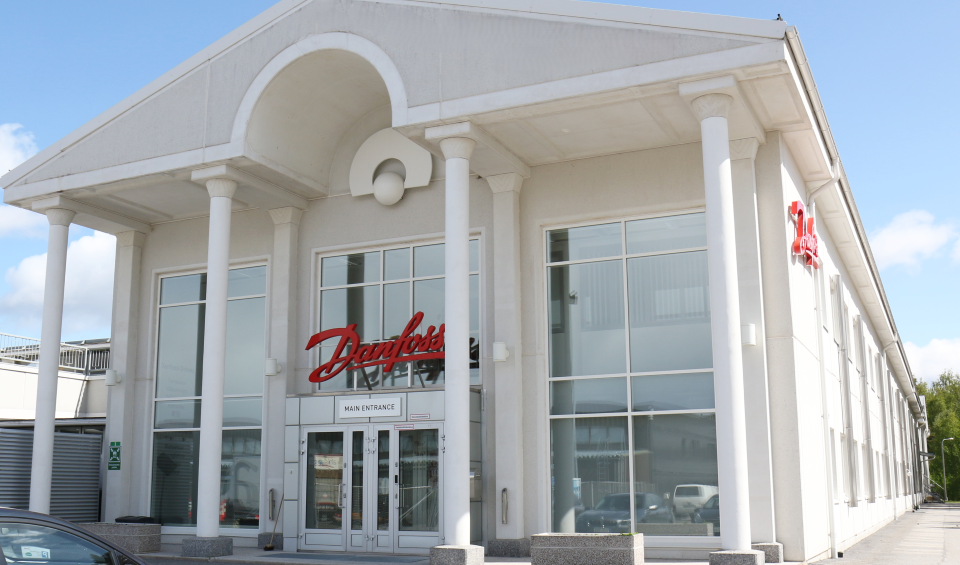
This series highlights the companies, innovations and faces of the EnergyVaasa cluster – while offering a closer look at what collaboration within the cluster looks like in practice. This time, we visit Danfoss, where Toni Honkakangas, Juha Holster and Maria Haavisto share their perspectives on electrification, energy efficiency and the technologies supporting the clean energy transition.
Danfoss is a global technology company developing solutions for more efficient energy use across a wide range of industries. One of its business areas, Danfoss Drives, focuses on technologies for controlling electric motors and managing electrical power. In Vaasa, the company plays an important role in developing high-power solutions used in industrial, marine and electrification applications.
Scroll down to discover how Danfoss Drives is developing solutions for increasingly electrified and connected energy systems, learn more about the iC7 series and see how collaboration within the EnergyVaasa cluster comes to life in projects such as Aurora Botnia. You’ll also get to know Toni Honkakangas, Juha Holster and Maria Haavisto – three people whose work spans marine technology, product marketing and communications.
Electrification and Energy Efficiency – click to read
In short, what does your company do, where do you operate, and who are your customers?
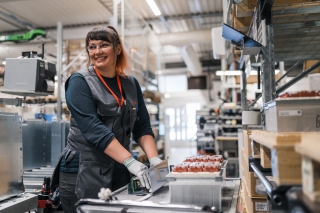
Danfoss develops technology that helps customers do more while using less energy. Our solutions are used in industry, buildings, energy systems, transport and at sea.
Danfoss Drives controls electric motors and converts electrical power intelligently. Electric motors account for a significant share of global electricity use, which means that controlling how and when that electricity is used can make a real difference in energy efficiency.
Danfoss is headquartered in Denmark and operates globally. In Finland, we have around 1,100 employees in Vaasa, Helsinki, Vantaa, Lappeenranta and Tampere. Vaasa has a global role in our high-power products, including variable-frequency drives, power converters, power modules and enclosed drive solutions.
Our customers range from equipment manufacturers and system integrators to shipyards, vessel owners, industrial companies, utilities and infrastructure operators.
What drives innovation and development at Danfoss Drives?
It starts with understanding what customers will need in the future, not only what they need today.
This is particularly important in the marine industry, where vessels and their main systems need to remain safe, reliable, efficient and competitive for decades. Customers need to reduce fuel and energy consumption, meet increasingly strict environmental requirements and prepare for further electrification and connectivity.
At the same time, a solution also has to make commercial sense. We combine knowledge of the application with engineering and work closely with customers and partners to turn long-term needs into solutions that can actually be built and produced at scale.
How does your work contribute to the clean transition?
In two areas where we know we can make a difference: electrification and energy efficiency.
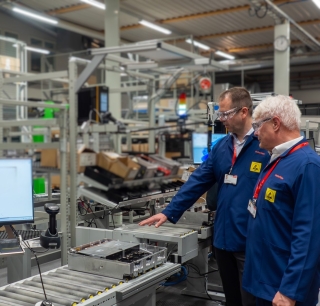
A variable-frequency drive adjusts the speed of a motor according to what the application actually needs at that moment. Without a drive, a motor may run at full speed even when considerably less would be enough. In systems with large motors operating for long periods, such as industrial plants and ships, this can result in significant energy savings.
In marine applications, we also enable electric and hybrid propulsion and connect batteries, shore power and other energy sources to the vessel’s electrical system.
We provide the power conversion and control technology that allows customers to use energy more intelligently today and introduce new energy sources when they become technically and commercially realistic.
What new trend in clean energy is most exciting – or most challenging – for Danfoss Drives right now?
One of the most interesting developments is that electrification, renewable energy, energy storage and digitalisation are no longer developing separately. They are increasingly becoming parts of the same systems.
A modern vessel, for example, may use several energy sources while simultaneously powering propulsion, charging batteries and running other onboard systems. When coordinated effectively, this can reduce both fuel consumption and emissions. At the same time, it makes the electrical system considerably more complex.
Our response is therefore to develop platforms rather than individual products. iC7-Marine and iC7-Hybrid cover propulsion, energy storage, shore power and charging within the same architecture, making it possible to adapt the system as needs and technologies evolve.
The iC7 series: a sustainable energy success story – click to read
What challenge are you solving with the iC7 series – and how?
Space is always limited on a vessel, particularly in the electrical room. At the same time, customers want more power without compromising efficiency or reliability, and the technology chosen today may eventually need to work together with solutions that are not yet commercially available.
The iC7 series was developed with this in mind. It is our most modern platform for variable-frequency drives and power converters and is the result of years of research and testing across Danfoss, with the Vaasa organisation playing a significant role in its development.
The platform controls electric motors, moves power in both directions between energy sources and storage, and provides a path towards hybrid or fully electric operation. Its modular architecture also means customers do not have to make every transition at once.
What makes the technology unique?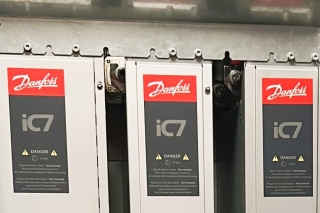
The strength lies in the combination of several features rather than one individual feature.
High power density is one important part. Liquid-cooled modules require considerably less space than an air-cooled solution with the same power. On a vessel, both space and weight are valuable.
Cybersecurity has also been built into the platform from the beginning rather than added afterwards, which is increasingly important as vessels and industrial systems become more connected.
Behind the technology are decades of experience in power electronics, motor control and demanding marine applications. The customer therefore gets not only the hardware, but also access to people who understand how it needs to work as part of a complete system.
What’s next for the iC7 platform?
The launch was the beginning rather than the end. The platform will continue to develop through expanded power and voltage ranges, new application functions and additional digital capabilities.
In marine applications, the transition towards hybrid and fully electric propulsion is creating new needs around energy storage, shore power, charging and DC distribution.
Not every operator will make the transition at the same pace, nor do they have to. The scalable platform allows shipowners to take the steps that make sense for their routes and business cases.
The goal is ultimately simple: if technology developed here in Vaasa can make customers more competitive while reducing real emissions, that is the result we want.
Collaboration Within the EnergyVaasa Cluster – click to read
If a startup joined the cluster today, what’s the first thing you would tell them to do?
Find out where you fit before deciding what you want from the cluster.
EnergyVaasa brings together large companies, SMEs, startups, universities, research organisations and the public sector. Take the time to understand what challenges these organisations are working on and where your own expertise can add something new.
The useful question is not only what the cluster can give you, but what challenge you and another organisation could solve together that neither could solve alone.
What role does collaboration within the EnergyVaasa cluster play for Danfoss Drives?
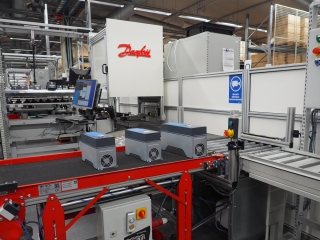
No company can solve the energy transition alone. The challenges involve power generation, power conversion, automation, manufacturing, software and system integration, and no single company specialises in all of them.
Vaasa brings much of this expertise together in one region: customers, suppliers, technology partners, research organisations and people with extensive experience in the field.
For marine and energy projects, that proximity matters. A drive or power converter may be at the heart of a solution, but it still has to work together with switchboards, automation, energy management and other systems supplied by different companies.
Can you give an example of how you’ve used the EnergyVaasa cluster network?
Aurora Botnia is a clear example. Wasaline’s ferry between Vaasa and Umeå brought together complementary expertise from several companies within the EnergyVaasa cluster.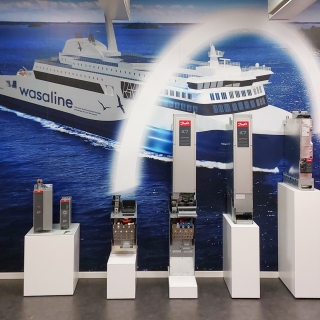
For Danfoss, this included close cooperation with WE Tech Solutions as the electrical system integrator and VEO in electrification and automation. When Aurora Botnia’s battery capacity was expanded, Wärtsilä was responsible for system integration while the Danfoss drives were reconfigured for the additional batteries and upgraded.
Today, there are 88 Danfoss iC7 drives and power converters on board, with a combined power of approximately 35 MW. They support propulsion, battery energy storage and essential onboard functions such as air conditioning and pumping. The expanded battery capacity also allows the vessel to operate on electricity when entering and leaving the harbour.
Faces of EnergyVaasa: Toni Honkakangas – click to read
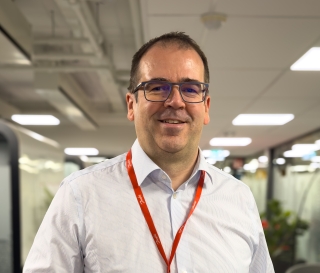 What is your role at Danfoss, and what does your workday look like?
I am responsible for the direction of our marine portfolio and its long-term success. In practice, the work is close to leading a business area. The portfolio, development
priorities, commercial direction and our capabilities all need to match what customers need while building a business that grows profitably.
There is no typical day. It can involve long-term strategy, a development review, a customer meeting, a commercial decision or working with a partner on an integrated solution.
What’s something people might be surprised to learn about your work?
How much of it is what I call “strategic time travel”.
A vessel designed today may still be operating in 30 or 40 years. We therefore have to make decisions for a world we can only partly see. Which fuels will be available and affordable? How will energy storage develop? What will regulators require?
The real task is not simply to meet today’s requirements. It is to help customers invest in very large assets in an energy landscape that is still taking shape.
What’s one project or achievement you’re especially proud of?
Bringing the liquid-cooled iC7-Marine and iC7-Hybrid families from an ambitious technology vision to a commercial platform.
I was part of most of that journey, which took years and involved people across research, product development, testing, manufacturing, quality and sales. Vaasa contributed at every stage.
Seeing the technology in use makes it especially meaningful. When something that began as a discussion in a meeting room is moving a ferry across the Kvarken, that is a different kind of satisfaction.
If budget and time were no issue, what dream project would you launch tomorrow?
A large-scale demonstration of zero-emission maritime transport – not just one vessel, but the whole system.
Renewable power generation, the port, charging infrastructure, energy storage and vessels would operate as one coordinated energy system. Almost all the necessary technologies already exist. The challenge is integrating them at scale and demonstrating that the result can be both reliable and commercially competitive.
EnergyVaasa would be a natural place for it because the expertise in energy, electrification, automation, marine technology and system integration already exists here.
What advice would you give someone looking for opportunities within the EnergyVaasa cluster?
Be curious, make yourself visible and come with something to offer.
Technical expertise is important, but the transition also needs software, data, manufacturing, project work, customer understanding, communication and business skills. Some of the best opportunities emerge where these areas meet engineering.
Faces of EnergyVaasa: Juha Holster – click to read
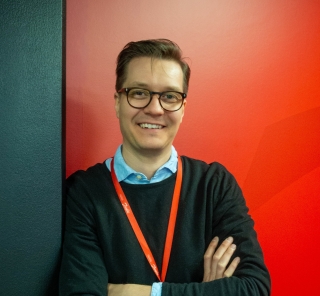
What is your role at Danfoss, and what does your workday look like?
I work as a Product Marketing Manager, connecting the product management team with sales colleagues, partners and customers around the world.
We’re currently bringing the new iC7 product series to market. Together with my colleagues, we support the rollout by raising awareness of the products and gathering market feedback to help make them even better.
What’s something people might be surprised to learn about your work?
I spend more time talking to engineers and sales teams than creating marketing materials.
What’s one project or achievement you’re especially proud of?
Our new iC7-Automation series has been well received by both new and existing customers, which makes me happy. My colleagues have done a fantastic job with the new, innovative product.
What advice would you give someone looking for opportunities within the EnergyVaasa cluster?
Be brave and open-minded. Even if your first job at a company isn’t exactly what you dreamed of, it can still lead you to your dream job later on.
Faces of EnergyVaasa: Maria Haavisto – click to read
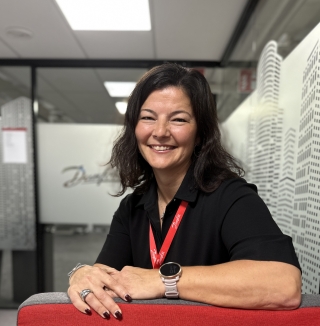 What is your role at Danfoss, and what does your workday look like?
I work as Marketing Communications Manager in the Western Europe team and am responsible for exhibitions and events, digital marketing and partner marketing.
A typical day can include planning upcoming exhibitions and events, creating social media content and campaigns, supporting partner marketing activities and onboarding new colleagues.
What’s something people might be surprised to learn about your work?
My responsibilities extend beyond Finland and the Baltic countries to Norway, the UK and Ireland. This has given me a broad understanding of our company’s marketing activities across different markets.
What’s one project or achievement you’re especially proud of?
We launched the Danfoss Drives Innovate concept globally, organising 16 partner and customer events across several locations. Through this concept, we engaged more than 1,000 customers from approximately 80 countries.
If budget and time were no issue, what dream project would you launch tomorrow?
I would create a comprehensive partner ecosystem – a strong network built around collaboration and mutual support, giving our partners an efficient path towards sustainable growth.
What advice would you give someone looking for opportunities within the EnergyVaasa cluster?
See EnergyVaasa as a complete ecosystem, not simply a collection of companies.
Network beyond your immediate field. Connect with people from universities, policy, finance and investment as well as other companies. Sharing knowledge across different disciplines can reveal new market opportunities, potential partners and entirely new perspectives.