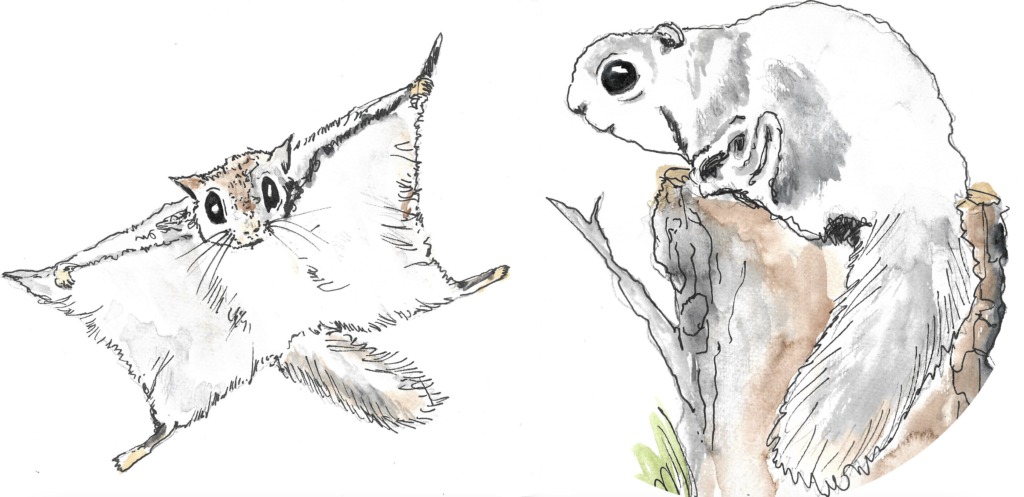
Flying squirrels (Pteromys volans) have been observed along the Kaupunginselkä route in Suvilahti and Hietalahti. On the Suvilahti housing fair area a Flying Squirrel Park has been left in its natural state, serving as a resting and breeding site for flying squirrels.
The flying squirrel’s back is silvery-grey and its belly fur is almost entirely white. Along the sides between the fore- and hindlimbs it has a skin fold that enables it to glide. The flying squirrel is an agile climber that can glide from tree to tree for distances of up to 50 metres.
The flying squirrel is most active at dusk and during the night. It favours old mixed forests, where it uses the old nesting cavity of the great spotted woodpecker as its nest. The nesting cavity is often in an aspen. The flying squirrel also lives close to humans in built-up areas, where it may nest in buildings or in bird boxes.
Flying squirrels mainly eat the leaves of deciduous trees. They also eat rowan berries, conifer buds and maple seeds. For winter food, the flying squirrel stores birch and alder catkins. The flying squirrel is an endangered and protected species in Finland.