
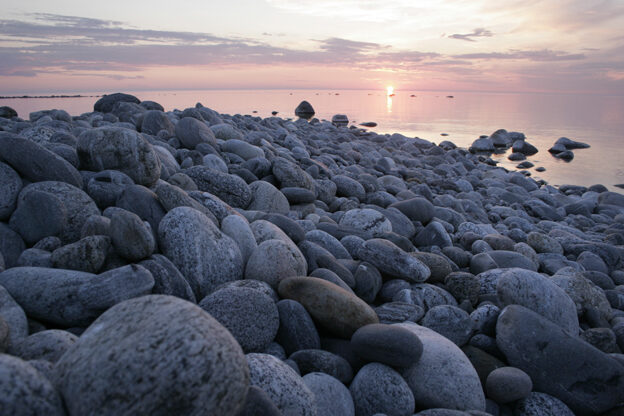
The High Coast/Kvarken Archipelago World Heritage Site is the best place in the world to experience and understand land uplift following the most recent Ice Age.
The Kvarken Archipelago and the High Coast form a joint World Heritage site of Finland and Sweden. The distance between the areas is 150 km. The High Coast and the Kvarken Archipelago are topographical opposites. The rare De Geer moraines of Finland’s low coast and the steep rocky shores on the Swedish side exemplify the geological land uplift phenomenon caused by the Ice Age that ended approximately 10,500 years ago.
Together the areas provide an illustration of the land uplift caused by the last Ice Age, and they are unique examples of ongoing geological and biological processes. An ice sheet up to three kilometres thick pressed the Earth’s crust down to about a kilometre depth. During the ice age, morain ridges and massive boulder fields formed in the Kvarken Archipelago. As the ice started to melt, the land began to rise from the sea, and this uplift continues today. Today the land in the Kvarken Archipelago rises by about 8 millimetres per year.
The High Coast / Kvarken Archipelago World Heritage Area
1
29.11.2000
Sweden’s High Coast is granted the World Heritage status because of its exceptional geology. In the environment of the Baltic Sea, there are no other such hilly areas and the highest points in the terrain are over 300 metres above the sea level!
2
16.7.2006
The Kvarken Archipelago was added to UNESCO’s World Heritage List as Finland’s first natural heritage site. As a result of the land uplift the area is a unique example of a continuously changing natural environment where habitats, vegetation and wildlife have adapted to the changes.
The High Coast and the Kvarken Archipelago form a joint World Heritage site of Finland and Sweden.
3
Who is responsible for the World Heritage?
Sweden and Finland jointly manage the World Heritage site. In Sweden the World Heritage area is overseen by Länsstyrelsen Västernorrland and in Finland by Metsähallitus.
4
How large is the area?
High Coast – 140,000 ha, of which 60,000 ha is land
Kvarken Archipelago – 194,400 ha, of which 29,300 ha is land
There are today as many as 5,600 islands in the Kvarken Archipelago!
5
Who lives in the World Heritage area?
The Kvarken Archipelago is home to residents of the municipalities of Korsholm, Korsnäs, Malax, Vaasa and Vörå.
On the High Coast the World Heritage municipalities are Kramfors and Örnsköldsvik.