



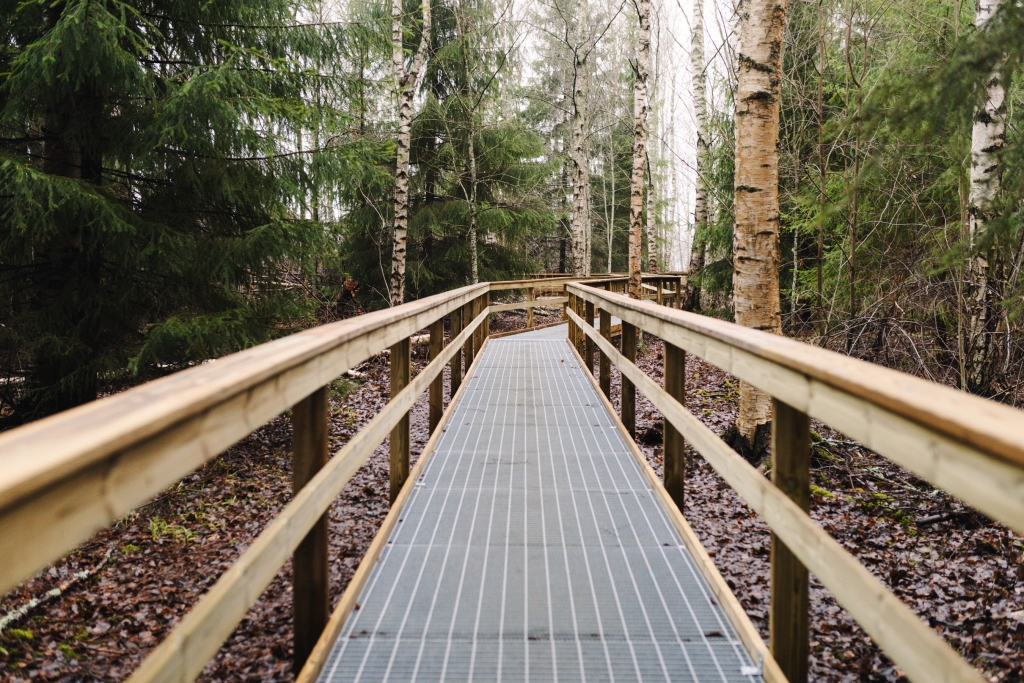
Onkilahti Nature Trail
The Onkilahti Nature Trail is located near Onkilahti Activity Park. Is gives easy access to nature.
The nature trail is about 220 metres long. It runs through the woods east of Onkilahti Activity Park, close to the cemetery and Paperisilta Bridge. The nature trail offers shade and coolness in the otherwise open activity park.
The nature trail is built from metal grating and has handrails on both sides. The handrails make the nature trail safe for everyone. Pets are welcome on the trail, but the metal grating may be uncomfortable for small paws.
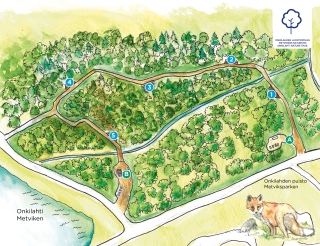
There are rest areas at regular intervals along the nature trail. At the rest areas there are information signs. Some of the signs have information in Braille (in finnish and swedish) for visitors with visual impairments. The signs gives information about the nature in the area. Wooden animal figures will be added later.
There is a larger rest area along the trail, with a birdhouse exhibition. There you can see different kinds of birdhouses for different birds.
You can reach the Onkilahti nature trail via the Onkilahti cycle and walking path, by public transport, and by car. There is a parking area nearby at Järvikatu 9.
The area is not maintained in winter, which means that the paths are not cleared of snow or gritted.
The nature trail has received support from the government’s ‘Get Finland Moving’ programme, which aims to promote physical activity for people of all ages.
The signs along the nature trail provide information about the surrounding nature in a clear and accessible text.
1. From ancient seabed to forest
Did you know that this area was once the seabed? Over time, the land rose and the water receded. Later, the city decided to establish a landfill here, and over the years the area became filled with waste.
Paperisilta Bridge (paperi = paper), also known as Putusilta, was built on top of the old landfill. The bridge got its name because children used to search for papers and pencil bits along the shore, left behind with office waste. Perhaps someone made secret drawings or wrote letters with them!
Guards controlled the types of waste that people were allowed to bring here. For example, rotting waste and toilet waste were strictly prohibited.
Finally, in the late 1960s, the landfill was closed and covered with soil. Today, the area is largely covered with forest – but old waste, and perhaps even some treasures, may still lie beneath the ground!
1. Invasive species and other newcomers
A large shrub called Siberian dogwood grows in the area. It is called an invasive species because it isn’t a native plant but was brought here by humans. Some invasive species take over space from plants that have been growing here for a long time. Siberian dogwood thrives in moist boreal forests and grows in dense clusters. Birds help spread Siberian dogwood by eating its berries, carrying the seeds to new areas in their droppings.
White hedge bindweed also thrives in the area. It is a climbing plant that can grow up to four metres long. It has white, trumpet-shaped flowers and large, heart-shaped leaves. White hedge bindweed has been used as an ornamental plant in gardens, but it has spread into the wild. It spreads through pieces of its roots.
An adventive species is a plant or animal that arrives in a new area without human help. They may travel to new areas carried by winds, ocean currents, or changes in the climate.
2. Wild animals in the city
Many animals live in towns and cities. They may find a suitable home in a park, a small wooded area, or a garden. Foxes, hares, flying squirrels, and bats are often active at dusk. If you pay close attention, you might catch a glimpse of them!
The fox is the cleverest urban traveller. They look for food in bins and know how to use pedestrian crossings. Foxes are masters of adaptation and thrive both in the wild and in the city.
The brown hare thrives in yards and on grassy fields. They can run very fast – up to 70 kilometres per hour. They rely on their speed and keen senses to stay safe.
Bats become active in the evening and set out to find food. They fly almost silently and navigate using echolocation. They emit very high-pitched sounds and listen for the echoes. The sounds help them ‘see’ in the dark, even though they are too far too high-pitched for us to hear.
The flying squirrel is the phantom of the forest, rarely seen by anyone. They sleep in tree hollows during the day and become active in the evening. They don’t actually fly, but they can glide from tree to tree for up to 80 metres. This is possible because flying squirrels have a membrane between their limbs that works like a sail.
.
3. Our winged neighbours
City birds are birds that regularly nest or feed in towns and cities. They are used to living near humans and benefit from the food and nesting sites the city provides.
In the city centre, you often see pigeons, birds belonging to the crow family, and seagulls. They like to eat food scraps left behind by people. In a park, you might see a starling or a fieldfare searching for worms on the lawn. In a nearby forest, you can hear the song of a chaffinch or a blackbird. A birdhouse in a garden tree may well attract a great tit, a sparrow, or a pied flycatcher.
Come autumn, many birds, including gulls, fly south to escape the winter cold. But because winters have become milder, more and more birds are staying to overwinter in Finnish towns and cities.
You can help wintering birds by putting seeds, nuts, or fat balls on a bird feeder. However, remember to let the birds feed undisturbed and keep the feeding place clean as well.
3. Who lives here?
Many birds like to live in tree hollows, but you can also help them find a home by building a birdhouse! They provide birds with shelter from rain, wind, and predators.
Birds come in different sizes and need different types of birdhouses. It’s very important that the entrance hole in the birdhouse is the correct size. There must be enough space inside the birdhouse, but it should not be too big or too small. The correct measurements are particularly crucial for small birds.
You can make a birdhouse from a cut log or from sawn boards. For the roof and base, use a material that can withstand rain. Some birds like to decorate the birdhouse themselves; others need a bit of help. Soft nesting materials help keep the eggs warm. Before you start building, find out what type of birdhouse a bird prefers for nesting. Each bird species has its own specific requirements.
Always ask the landowner for permission before attaching a birdhouse to a tree.
4. Trees in the nearby woods
The vegetation and soil in the Onkilahti area are young and partly shaped by human activity. The area was formed as a result of land uplift and infill. The soil mainly consists of clay and bottom silt.
On top of the clay is a very thin layer of humus, formed from the remains of dead plants and organisms. It takes a long time for this layer to form, and in many parts of the area it is missing altogether. This affects how well plants can grow, as humus is important for both plants and small organisms.
The area is home to pioneer plants, which are the first to colonise newly formed ground. They thrive in wet clay and need plenty of light. Common trees include alder, birch, willow, bird cherry, and rowan. Spruces also grow in the drier spots. The ground is mostly covered with moss and grass, but there are also nettles, raspberries, ferns, and marsh marigolds.
In winter, trees and shrubs can be identified by their shape and colour. You can see whether the trunk is thick or thin, dark or light. The branches can be smooth or rough. Buds can be large or small, pointed or round, sticky or furry.
4. Hidden underground
The soil in this forest is mostly hard clay – over 60 per cent of it is clay. Clay is rich in nutrients but so dense that it typically lacks oxygen. The groundwater is also close to the surface here. Dense clay and the lack of oxygen make it difficult for tree roots to grow; only the smallest roots can reach deeper. As a result, the roots grow close to the surface, leaving the trees vulnerable in strong winds. There are already young trees in the area that have been blown over.
When a tree dies, it slowly begins to decay. Standing dead trees provide food for woodpeckers and nesting sites for other birds. They are also important for fungi, beetles, and lichens.
Decaying trees on the ground attract a variety of species, as the environment there is damper and darker.
The underground is crawling with life. It is home to tiny organisms, such as fungi, bacteria, insects, and worms. They break down dead plants and animals, helping living plants access nutrients and water. In this way, they keep the forest’s cycle of life going
5. Birds in Onkilahti
Onkilahti is home to a wide variety of waterfowl. Each bird species has its own way of living and finding food. The whooper swan is a dabbler, stretching its long neck underwater to feed on aquatic plants. The great crested grebe is a diver. It dives completely underwater and hunts small fish. The common coot, on the other hand, dives underwater in search of aquatic plants and invertebrates.
In the northern end of Onkilahti Bay, there is a small artificial island. It is home to nesting common gulls, black-headed gulls, and terns They defend their nests fiercely and, in doing so, also help protect other birds from predators. Near the island, you can see common goldeneyes, mallards, and tufted ducks.
The reed beds along the shore are alive with bird calls. The birds are often hard to spot, but you can learn to recognise them by their calls. The reed bunting’s song is a bright, simple ‘tsee’, the sedge warbler’s a hurried, chattering ‘chek’, and the Eurasian reed warbler’s a short, repetitive ‘tret’.